
No featured images
-
Menu
- Home
-
Germany
-
-
-
-
-
Awards
- Mounted Ribbons Bars
- Imperial Germany 1871–1918
- Iron Cross and War Merit Cross
- Combat Awards
- Luftwaffe Awards
- Kriegsmarine Awards
- Campaign Awards
- Year Long Service Awards
- Political and Civil Awards
- Wound Badges
- Sports Awards
- German Ribbon Bars
- Feldmarschall batons
- Award Documents, Citations and Cases
-
-
-
USA
-
- Spain
-
Replica Guns
-
-
-
Warning
Wilden Militaria disclaims all liability for misuse of items sold through this website.
All items featured on this page are only decorative and / or collectible character, so the company is not responsible for the misuse, improper handling or manipulations that they can suffer. Imitations of knives, by the material they are made, lack edge by both sides and the firearms lack appropriate for it and have the obstructed barrel mechanisms.
All items are available to be enjoyed at home, at exhibitions collectibles, or for theatrical or entertainment purposes, and always under the supervision of a responsible adult. They should never be exposed in the street, pointing them to anyone because it could cause alarm or be seen as a threat, be hidden in clothing, or left carelessly in the car.
The public sale of these items conform to the regulations of free trade without being affected by the "Regulations on Arms", as is clear from the opinion of the "Permanent Interministerial Commission on Arms and Explosives" (CIPAE) dated in November 7, 1995 and the "Intervention Central Weapons and Explosives" (ICAE) of "General Directorate of the Civil Guard."
PLEASE CHECK LAWS OF YOU COUNTRY. WE DON'T SEND THIS ITEMS OUTSIDE EUROPEAN COUNTRY.
-
-
- Vehicles
-
The Shop
-
- New products
- Blog
-
Help
-
-
-
-
-
Information
-
-
-
Menu
- Home
-
Germany
-
-
-
-
-
Awards
- Mounted Ribbons Bars
- Imperial Germany 1871–1918
- Iron Cross and War Merit Cross
- Combat Awards
- Luftwaffe Awards
- Kriegsmarine Awards
- Campaign Awards
- Year Long Service Awards
- Political and Civil Awards
- Wound Badges
- Sports Awards
- German Ribbon Bars
- Feldmarschall batons
- Award Documents, Citations and Cases
-
-
-
USA
-
- Spain
-
Replica Guns
-
-
-
Warning
Wilden Militaria disclaims all liability for misuse of items sold through this website.
All items featured on this page are only decorative and / or collectible character, so the company is not responsible for the misuse, improper handling or manipulations that they can suffer. Imitations of knives, by the material they are made, lack edge by both sides and the firearms lack appropriate for it and have the obstructed barrel mechanisms.
All items are available to be enjoyed at home, at exhibitions collectibles, or for theatrical or entertainment purposes, and always under the supervision of a responsible adult. They should never be exposed in the street, pointing them to anyone because it could cause alarm or be seen as a threat, be hidden in clothing, or left carelessly in the car.
The public sale of these items conform to the regulations of free trade without being affected by the "Regulations on Arms", as is clear from the opinion of the "Permanent Interministerial Commission on Arms and Explosives" (CIPAE) dated in November 7, 1995 and the "Intervention Central Weapons and Explosives" (ICAE) of "General Directorate of the Civil Guard."
PLEASE CHECK LAWS OF YOU COUNTRY. WE DON'T SEND THIS ITEMS OUTSIDE EUROPEAN COUNTRY.
-
-
- Vehicles
-
The Shop
-
- New products
- Blog
-
Help
-
-
-
-
-
Information
-
-
The swastika in Finnish military aviation
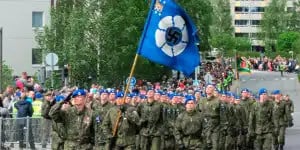
The photo is from a few years ago, and it is not about any neo-Nazi group: they are members of the Finnish Air Force, specifically the Air Command of Lapland. What we see in the banner is what they call it "Hakaristi", which is what is called swastika in Finnish. And how is it possible for a country in the European Union to consent to the public use of a symbol associated with Nazism? For this we have to go back in history almost a hundred years ago.
The swastika in Finnish military aviation
December 6, 1917 and in full Bolshevik revolution, the former Tsarist Duchy of Finland declared its independence from Russia. Shortly after the country gets into a Civil War that faces the red camp (social democratic rebels, supported by the Russian Bolsheviks) and the white camp (formed by the Senate, conservative majority, supported by the German Empire and volunteer forces arrivals from Poland, Sweden and Estonia). The brief contest - it does not reach five months - will result in 37,000 deaths and the victory of the whites. Although Germany aims, with conservative support, to put a German monarch as Head of State of Finland, its defeat in the Great War truncates that plan and the country becomes a parliamentary republic.
Two months before the end of the Civil War, the Aviation Corps of the Finnish Army was created on March 6, 1918. On February 25, his first military plane arrived in the country: a German biplane Albatros B.II purchased by the director of the Swedish newspaper Aftonbladet, Waldemar Langlet, a supporter of the white side. The second Finnish military aircraft was donated by the Swedish Count Eric Von Rosen: it was a Thulin Typ D, a variant of the French monoplane Morane-Saulnier L manufactured in Sweden. This device arrives in Finland on March 6 and it is painted with the personal emblem of Von Rosen: a blue swastika. The emblem does not have in 1918 the bad connotations that it has today: it is a symbol associated with the Viking past of the Nordic countries. On March 18 Marshal Mannerheim, commander-in-chief of the Finnish military forces, adopts that blue swastika as an emblem of the Army Aviation Corps.
An emblem of good luck for many aviators of the time
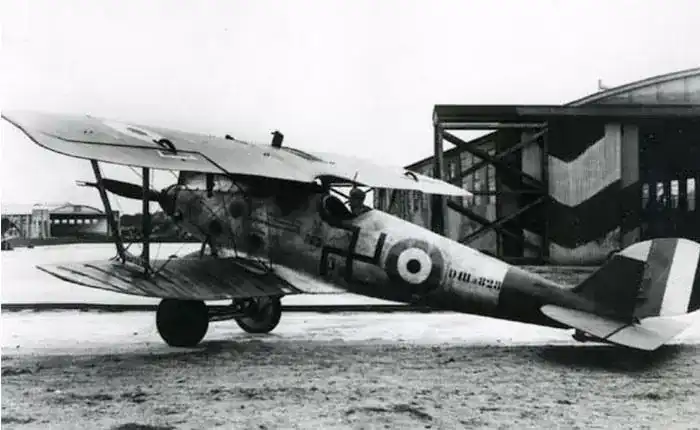
The swastika became popular in the early twentieth century in the Nordic countries as a Viking emblem associated with good luck. Eric Von Rosen had already used it on a trip to Latin America in 1901. After its adoption by the Finnish military aviation, it is adopted by the Lotta Svärd, a paramilitary women's auxiliary organization formed in 1918 and dedicated to providing health care and other auxiliary tasks. for the Army. The National German Socialist-Worker Party (1920) and the Italian Fascist Party (1921) have not yet appeared when Finland adopts that symbol. It must be said that its use in airplanes is not atypical at that time. In the First World War they use the swastika aviators of both sides as a symbol of good luck. So do, for example, the American ace Raoul Lufbery Squad Lafayette, and the German ace Werner Voss, who died during the race. In the interwar period, it continues to be used for that purpose. Here we see, for example, a German fighter Pfalz D.III captured by the French at the end of the First World War, which was suppressed the emblems with the German Schwarzes Kreuz (black cross), to add galas rosettes and a sauvastica ( an inverted swastika, sign of bad omen, the pilot must have been misinformed):

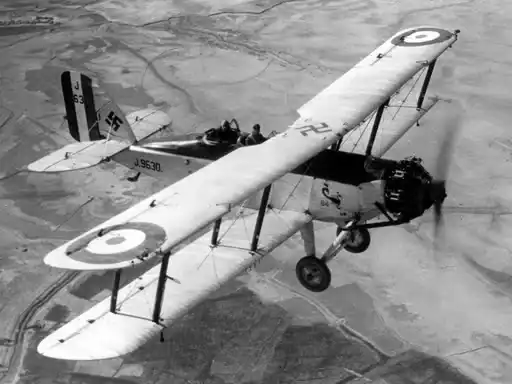
Under these lines, a Westland Wapiti of the British RAF in the interwar period, with a swastika at the tail rudder and a sauvastica on the upper wing:

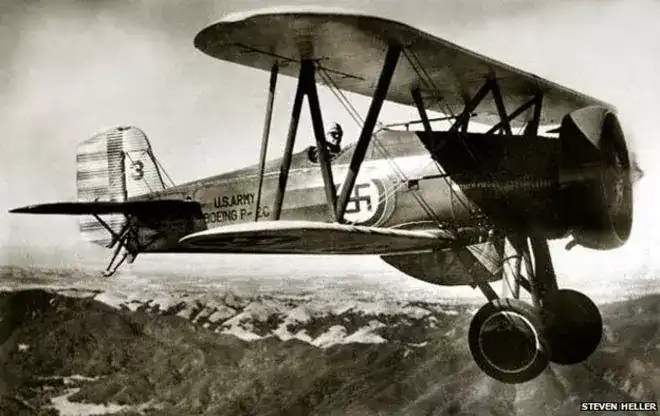
A Boeing P-12 of the Air Corps of the United States Army, also from the interwar period, with a swastika painted on the fuselage as a symbol of good luck:

The Finnish swastika after the rise of Nazism
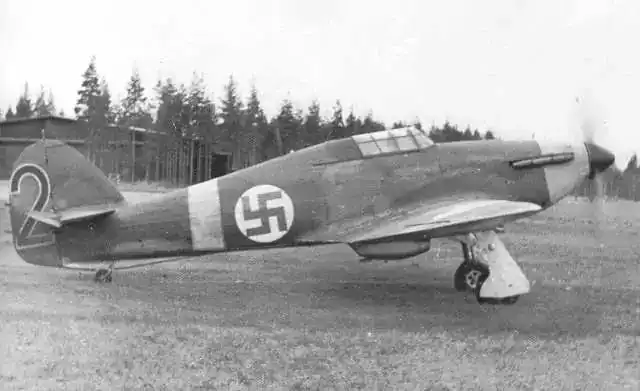
The rise to power of the Nazi Party in Germany and its dictatorial and anti-Semitic measures make the swastika acquire very negative connotations even before the outbreak of the Second World War. However, Finland continues to use that symbol, as it is a historical emblem of its nation. After all, Finnish democracy had been using it long before the Third Reich. When the Winter War broke out (1939-1940) after the Soviet invasion of Finland, the country still carries swastikas on its planes, but it does not do so as an ally of Germany. Rather, the countries that support Finland against the Soviet invasion are Britain and France. This aid includes the sale of war material, also fighter aircraft. Here we can see one of the 12 Hawker Hurricane bought by Finland to the United Kingdom at the end of that contest:

The reappearance of the 'Hakaristi' after the Second World War
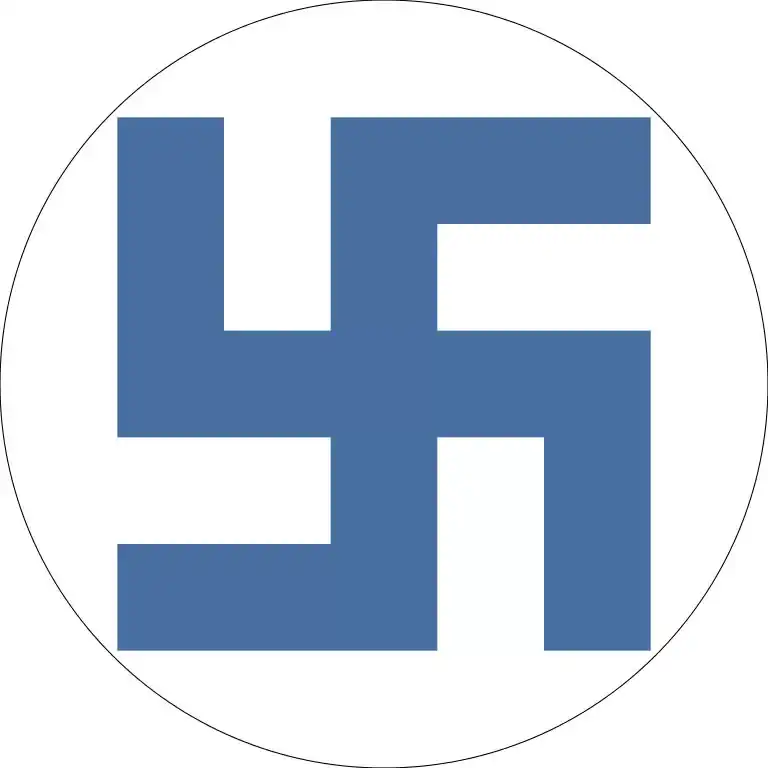
At the end of the War of Continuation (1941-1944), the swastika disappears from the Finnish aircraft as required by the Allies. Instead, the Finnish military aviation adopts a circular cockade white, blue and white, which still shine today military aircraft in the country.
![]() |
![]() |
Left: Emblem used by the Finnish Air Force aircraft between 1918 and 1944. On the right, the cockade adopted at the end of the Second World War, and still in force today. |
|
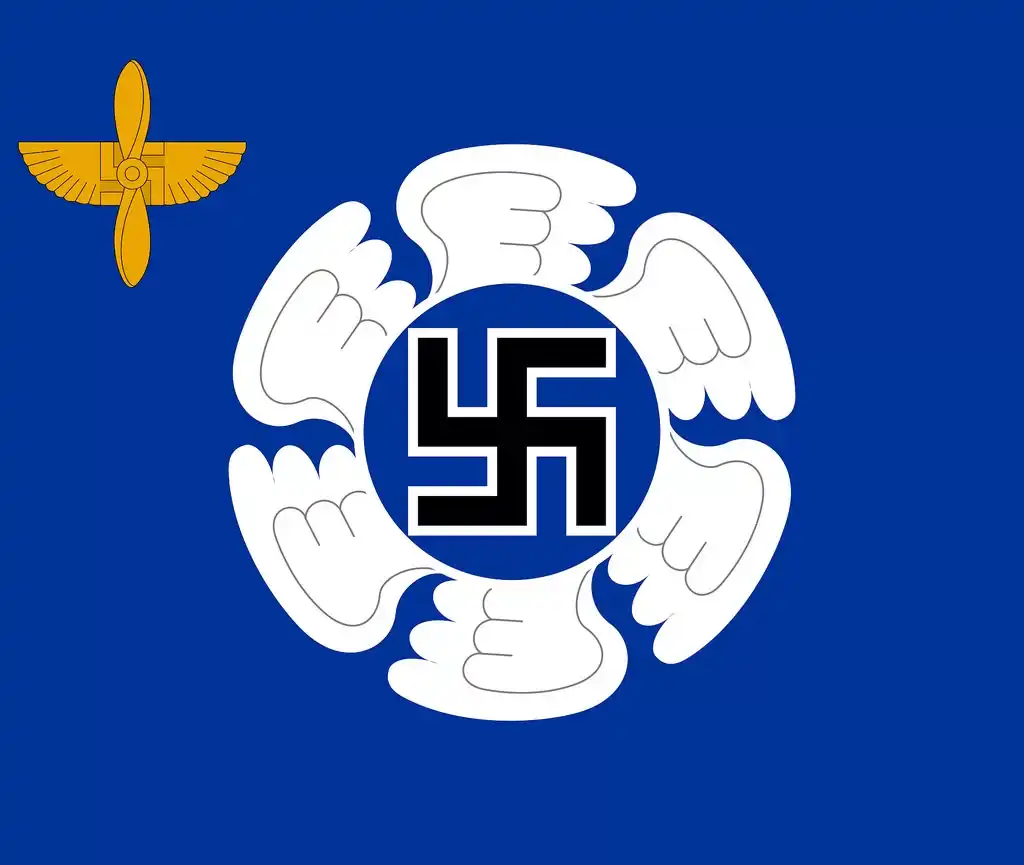
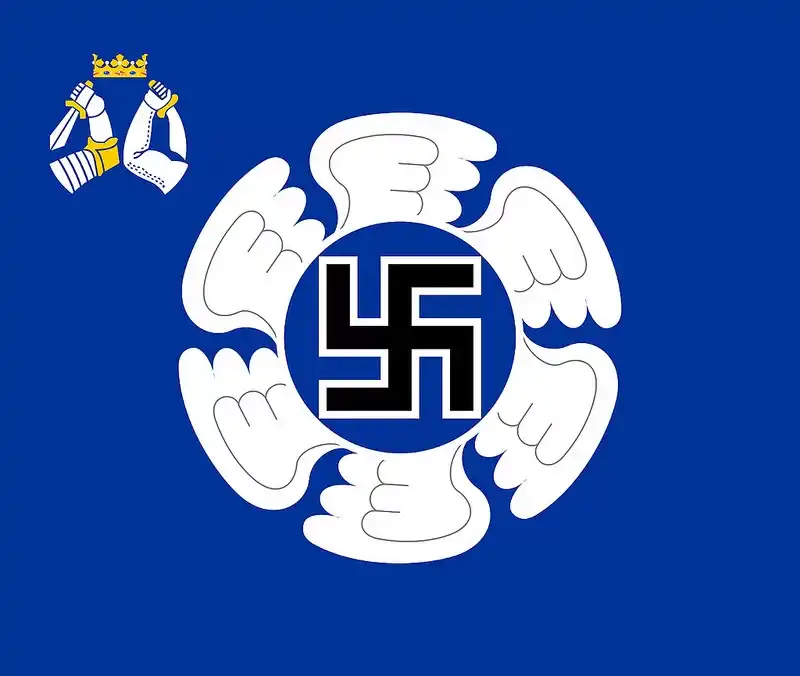
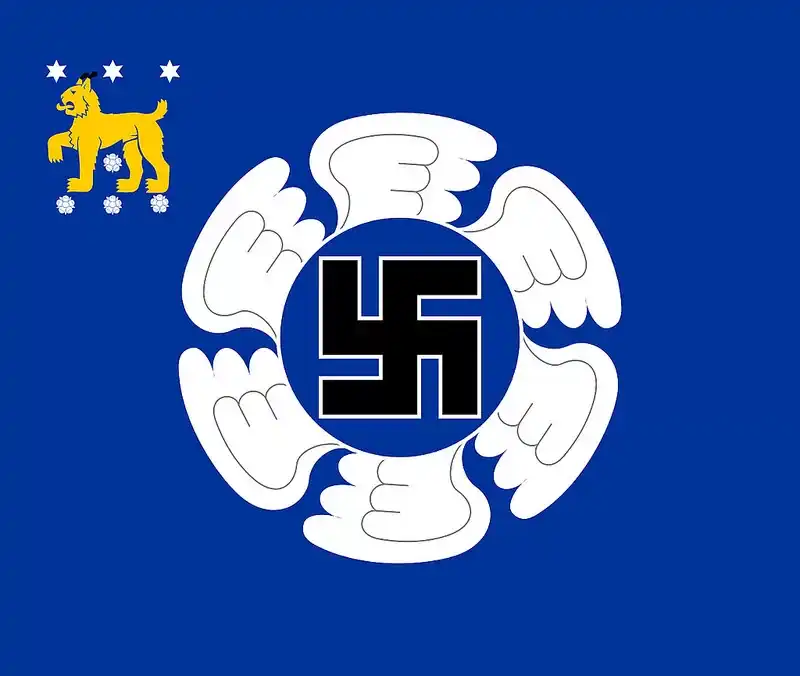
However, already in the 1950s some units of the Finnish Air Force recovered the "Hakaristi" in a black design edged in white and blue background. Today we can see it, as I have already pointed out, in several banners of the Finnish Air Force. Under these lines we see, on the left, the banner of the Air Force Academy (Ilmasotakoulu) based in Tikkakoski, which not only sports the aforementioned black swastika, but also another gilt, hidden behind the propeller that appears on the top left. On the right is the standard of the Satakunta Air Command (the following four images are the work of Olof Eriksson):
![]() |
![]() |
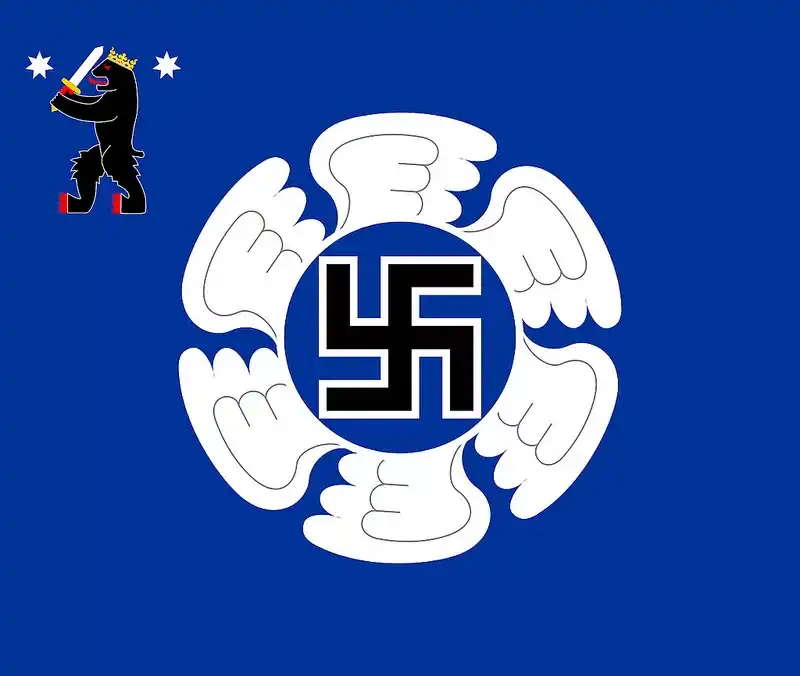
And under these lines we see, on the left, the standard of the Karelian Air Command, and on the right, that of the Lapland Air Command:
![]() |
![]() |
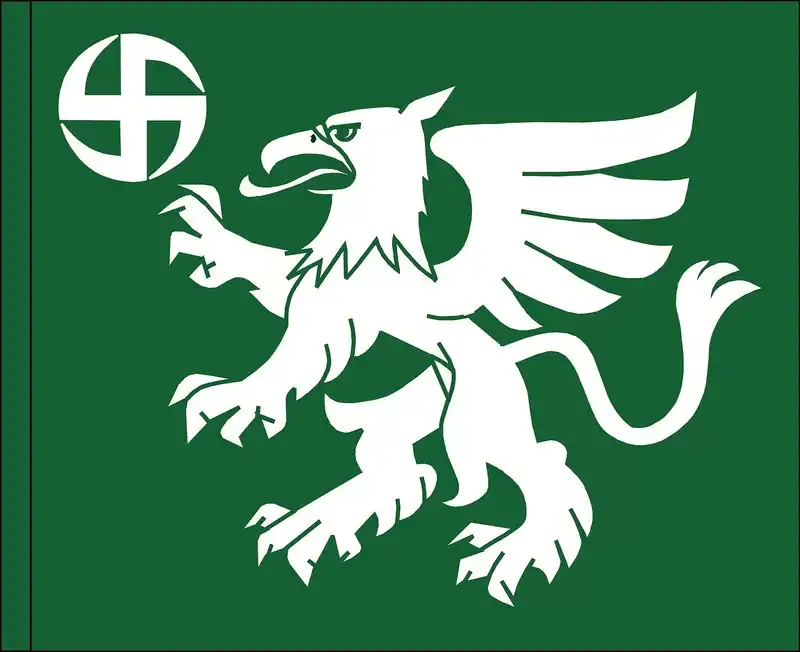
There is also a circular version of the swastika on the banner of the Utin Jääkärirykmentti, a regiment of the Finnish Army specialized in the training of helicopter pilots and in the training of special forces (image: Liisa Kontiainen / Wikimedia):

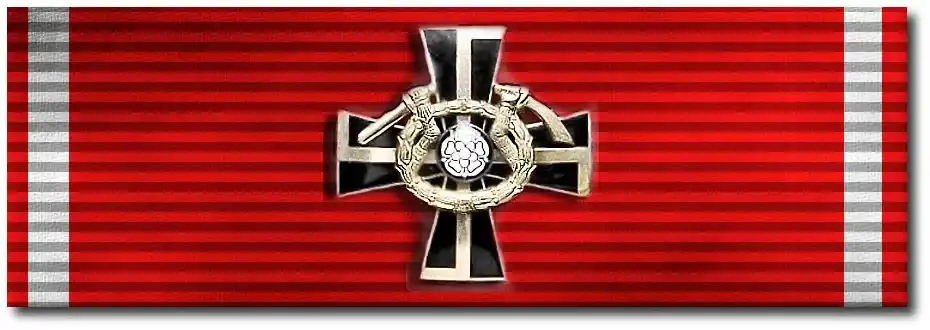
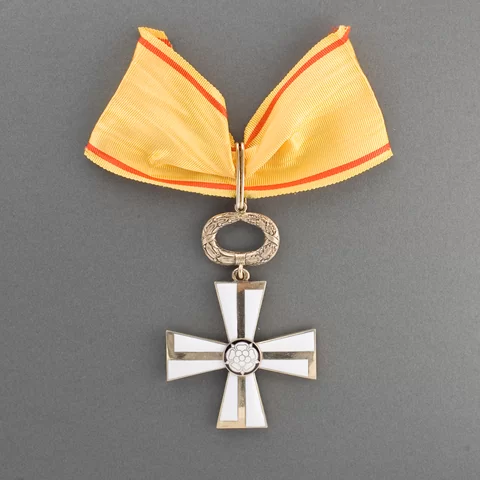
The highest Finnish military decoration, the Cross of Mannerheim, also sports a swastika, albeit disguised, as can be seen in this image (photo: Vesteri / Wikimedia):

We can find a similar design on the Cross of the Order of Liberty, one of the three civil decorations awarded by the Republic of Finland (photo: Kunniamerkit / Wikimedia):

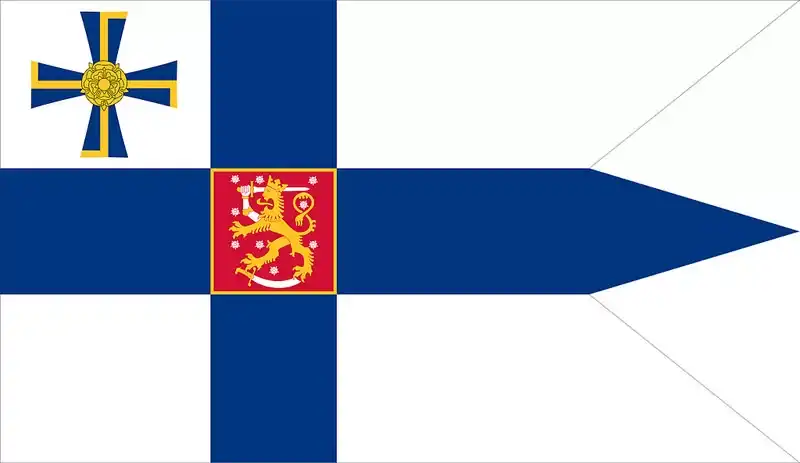
This decoration is, of course, on the Finnish Presidential Standard:

A symbol that maintains its historical roots in Finland
From time to time there are still polemics in Finland itself due to its use, and also in foreign media. In October 2005 the French newspaper Le Monde dedicated an article to him. In December 2007 the German weekly Der Spiegel dealt with it, in a more critical tone. Until today, the roots of the "Hakaristi" in Finland remain despite the controversy, and certainly not because of any sympathy with Nazism: Finland is, since its independence, a democratic country. In spite of this, the horrendous crimes committed by the Nazis, symbolized in the swastika, have caused their connotations to remain so negative that, due to their historical roots prior to the Third Reich, their use is still shocking. of a country that-after all-was allied with Nazi Germany in the War of Continuation.
Source : Contando Estrellas, http://www.outono.net/elentir